

Kalapana Orchid Farm
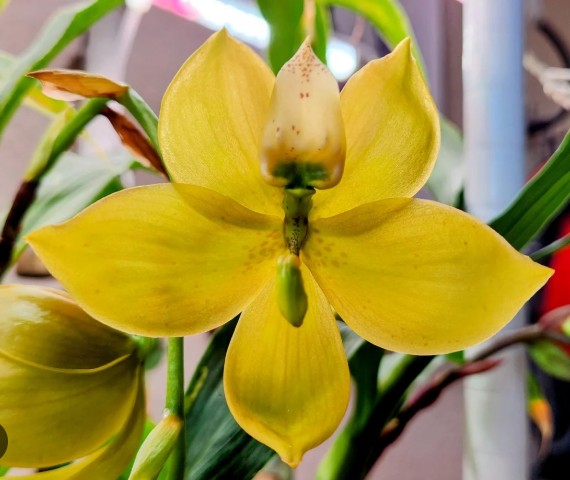
Cyc. Cygnus Atratus x Cyc. Brown's Choice 'Spotted Swan'
Cyc. Cygnus Atratus x Cyc. Brown's Choice 'Spotted Swan'
Couldn't load pickup availability
The name Cycnoches, meaning "Swan Orchid," is one of the most fitting in the orchid world. A glance at the male flowers, with their gracefully arched column resembling a swan's neck and head, immediately explains why. This particular hybrid is a cross between Cycnoches Cygnus Atratus and Cycnoches Brown's Choice 'Spotted Swan', combining some fantastic genetics for a truly dramatic result.
To understand what we have here, we need to look at the family tree, which traces back to the warm, humid, lowland forests of Central and South America. The grandparents are heavy hitters. Cyc. Cygnus Atratus brings in the influence of Cyc. barthiorum from Colombia, a species known for its incredibly dark, almost black, fragrant flowers. The other major influencer is Cyc. warscewiczii, from Panama and Costa Rica, which provides large flower size and the classic swan shape. The other parent, Cyc. Brown's Choice, combines Cyc. warscewiczii with Cyc. cooperi, a wonderfully spotted species from Brazil and Peru. The 'Spotted Swan' cultivar name tells us exactly what it brings to the party: prominent, beautiful spotting.
So what happens when you cross the potential for solid dark color with heavy spotting? You get a flower that is bound to be a showstopper. Expect a gracefully arching or pendant spray of blooms, each showcasing that signature swan-like form. The color will likely be a deep, rich burgundy or chocolate-brown, overlaid with even darker spots and blotches. The potential for intensely saturated, dark flowers is very high. And the fragrance should be remarkable—Cycnoches are famous for their powerful, often spicy or sweet scents that can fill a room.
A Note on Male & Female Flowers
One of the most fascinating traits of the Cycnoches genus is its ability to produce separate male or female flowers. The plant decides which to produce based on the growing conditions. Lower light tends to produce the elegant male flowers, which are smaller and more numerous on a long, gracefully pendant inflorescence. These are the classic "swan" flowers with the intricate, arched column.
Under very bright light and with optimal nutrition as the pseudobulb finishes maturing, the plant may produce female flowers instead. These are a completely different affair. They are much larger, heavier, and fleshier, with a helmet-like shape. You'll only get a few on a shorter spike, and they lack the swan-like column of the males. They are built for business—specifically, for being pollinated and producing a large seed pod. It's a real treat to see the female flowers, as they are produced less frequently. On rare occasions, a plant can even produce both types of flowers on the same spike.
The plant itself has a fascinating and dramatic life cycle dictated by its native habitat's wet and dry seasons. It grows from prominent, cigar-shaped pseudobulbs that can get quite large. In late summer, the plant is in its peak growth phase. New pseudobulbs rapidly mature, drawing energy from large, broad, pleated leaves. These leaves are thin and quite delicate. Come late fall or winter, after blooming, the plant will enter a necessary dormancy. The leaves will yellow and fall off, leaving the bare pseudobulbs to rest until spring. This deciduous nature is perfectly normal and essential for the plant's health and future flowering.
Care Instructions
Light: During the active growing season (spring and summer), provide very bright, indirect light, similar to Cattleya conditions. An east or south-facing window with some shading from the direct midday sun is ideal. Once the leaves drop for dormancy, light can be reduced.
Water: This plant's water needs are dictated by its growth cycle. When new growth appears and roots are actively growing, water heavily and frequently, keeping the medium consistently moist. Do not let it dry out completely during this phase. Once the leaves begin to yellow and fall in autumn, drastically reduce watering. During the winter dormancy, provide no water at all, only resuming when new growth and roots appear in the spring.
Temperature: As a lowland tropical native, it thrives in warm conditions. Daytime temperatures of 75-90°F are ideal, with night temperatures between 60-65°F.
Humidity: Prefers high humidity, from 50% to 70%. Good air circulation is crucial, especially during the growth phase, to prevent rot on the new growth and large leaves.
Potting Medium: Use a medium that holds moisture well but also provides good drainage. A mix of sphagnum moss with some medium-grade fir bark and perlite is an excellent choice. Choose a pot that is just large enough for the root system, as they prefer to be slightly under-potted. Repot only when new growth and roots are starting, typically in the spring.
*Please note, photos are examples of the parents of this cross. Offered in 3" pots, in spike.
Share