

Kalapana Orchid Farm
Cyc. warscewiczii
Cyc. warscewiczii
Couldn't load pickup availability
The orchid species Cycnoches warscewiczii produces large, dramatic flowers known for their distinct swan-like structure. The waxy blooms are typically a bright chartreuse to golden green, featuring a fleshy, white column that curves gracefully over an intricate lip. This species exhibits pronounced floral dimorphism, meaning a single plant can produce entirely different male or female flowers depending on seasonal environmental conditions. The male flowers appear in greater numbers on arching, multi-flowered spikes, while the female flowers are fewer, noticeably heavier, and present a more robust structure. A strong, sweet fragrance reminiscent of ripe bananas or mint is released by the blossoms during the morning hours.
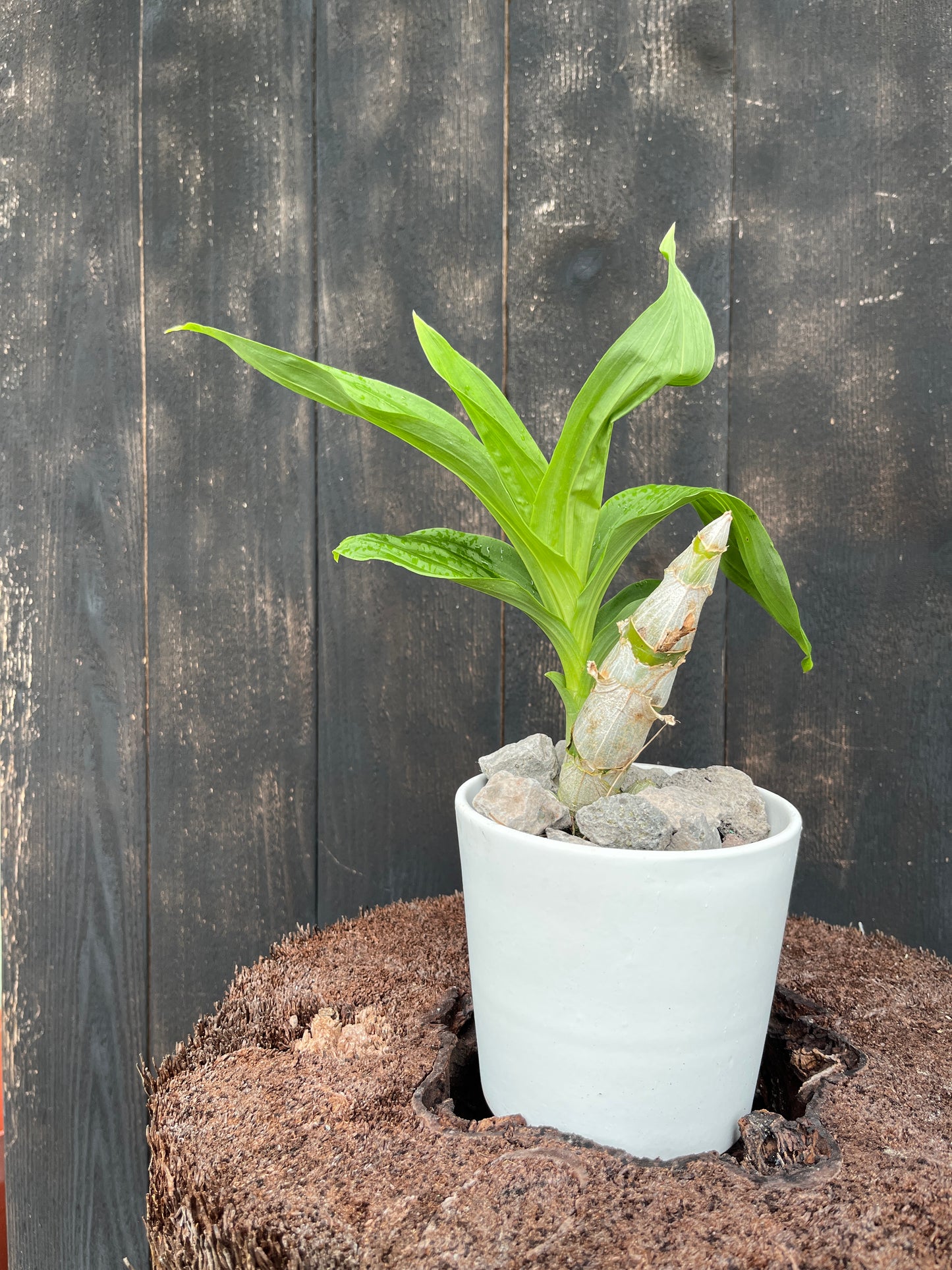
The vegetative body of this orchid consists of large, heavy, spindle-shaped pseudobulbs that function as storage organs for water and nutrients, often growing 8 to 15 in. tall. From the upper nodes of these thick stems emerge thin, plicate, lance-shaped leaves with distinct parallel veins and a light green coloration. As a deciduous member of the Catasetinae alliance, the foliage completes its lifecycle within a single season. In late autumn, the leaves naturally turn yellow and drop off entirely, leaving behind bare, silvery-green pseudobulbs that remain dormant throughout the winter months.
Quick Start Summary
Light: Bright filtered light, avoiding direct afternoon sun
Temps: Warm to hot during active growth between 75 and 90 F, dropping cooler during winter dormancy
Water: Heavy and frequent watering while growing, drastically reduced to a light splash once every two weeks during winter rest
Humidity: High levels between 60% and 80% with continuous air movement
Fertilizer: Balanced orchid fertilizer applied weekly at full strength only during the active summer growth phase
Media: Free-draining mix such as medium fir bark combined with perlite and charcoal, or packed sphagnum moss in clay pots
🌺 Orchid Lore & Discovery
This species is native to the tropical, warm, moist forests of Central and South America, with significant populations found in Costa Rica, Panama, Colombia, and Venezuela. It was named in honor of Josef Warszewicz, a prolific nineteenth-century Polish botanist and plant collector who documented the species growing as an epiphyte on the trunks and major limbs of large canopy trees. In its natural habitat, the orchid experiences a distinct yearly climate pattern characterized by months of torrential seasonal rainfall followed by a severe, prolonged dry winter. This environmental cycle directly shaped the dramatic growth and complete leaf-shedding adaptation that the species maintains.
🌿 How to Grow Cyc. warscewiczii
Light: Provide high light levels consisting of bright, diffused sunlight. A location near an east-facing window or a lightly shaded south-facing window offers ideal illumination. The intensity of light received during the early development of the flower spike influences the sex of the blossoms, as higher light levels tend to trigger the development of female flowers, while moderate shade encourages male flowers.
Temps: Maintain warm to hot temperatures throughout the spring and summer months when the orchid is actively growing. Day temperatures should range between 75 and 90 F, with a night drop down to 65 or 70 F. During the winter rest period, the bare pseudobulbs prefer cooler temperatures around 60 to 65 F, but they must always be protected from freezing conditions.
Water: Follow a strict dual-phase watering routine tailored to the seasonal cycle. When new growth emerges in spring, withhold heavy watering until the new roots are at least 3 to 5 in. long to prevent rot. Once established, water heavily and frequently to keep the medium moist through summer. When the flowers fade and leaves drop in late autumn, stop regular watering entirely, providing only a light splash every two weeks to keep the bulbs from shriveling.
Humidity: Keep atmospheric humidity levels between 60% and 80% throughout the entire year. Excellent air movement is necessary to prevent stagnant moisture from causing fungal spots on the thin, veined foliage. Utilizing an oscillating fan alongside a humidifier helps maintain the appropriate air balance indoors.
Fertilizer: Feed the plant heavily only during its rapid summer growth phase. Apply a balanced orchid fertilizer at full strength with every watering to help the plant build up the massive pseudobulbs required for flowering. Discontinue all fertilizer use immediately when the leaves begin to yellow in autumn, and do not fertilize during the winter dormancy.
Media: Choose a potting medium that retains moisture during summer but dries out quickly enough to prevent root suffocation. Premium sphagnum moss packed tightly into clay pots works well for growers in dry environments, while a mix of medium fir bark, charcoal, and perlite is better suited for high-humidity greenhouses. Repotting must only be done in early spring when the new growth is just beginning to sprout and before the new roots have grown long enough to be broken during handling.
Grown in 3" pots.
Share