

Kalapana Orchid Farm
Cyc. cooperi ‘Dark Star’ x Cyc. Richard Brandon ‘Heavy Spots’
Cyc. cooperi ‘Dark Star’ x Cyc. Richard Brandon ‘Heavy Spots’
Couldn't load pickup availability
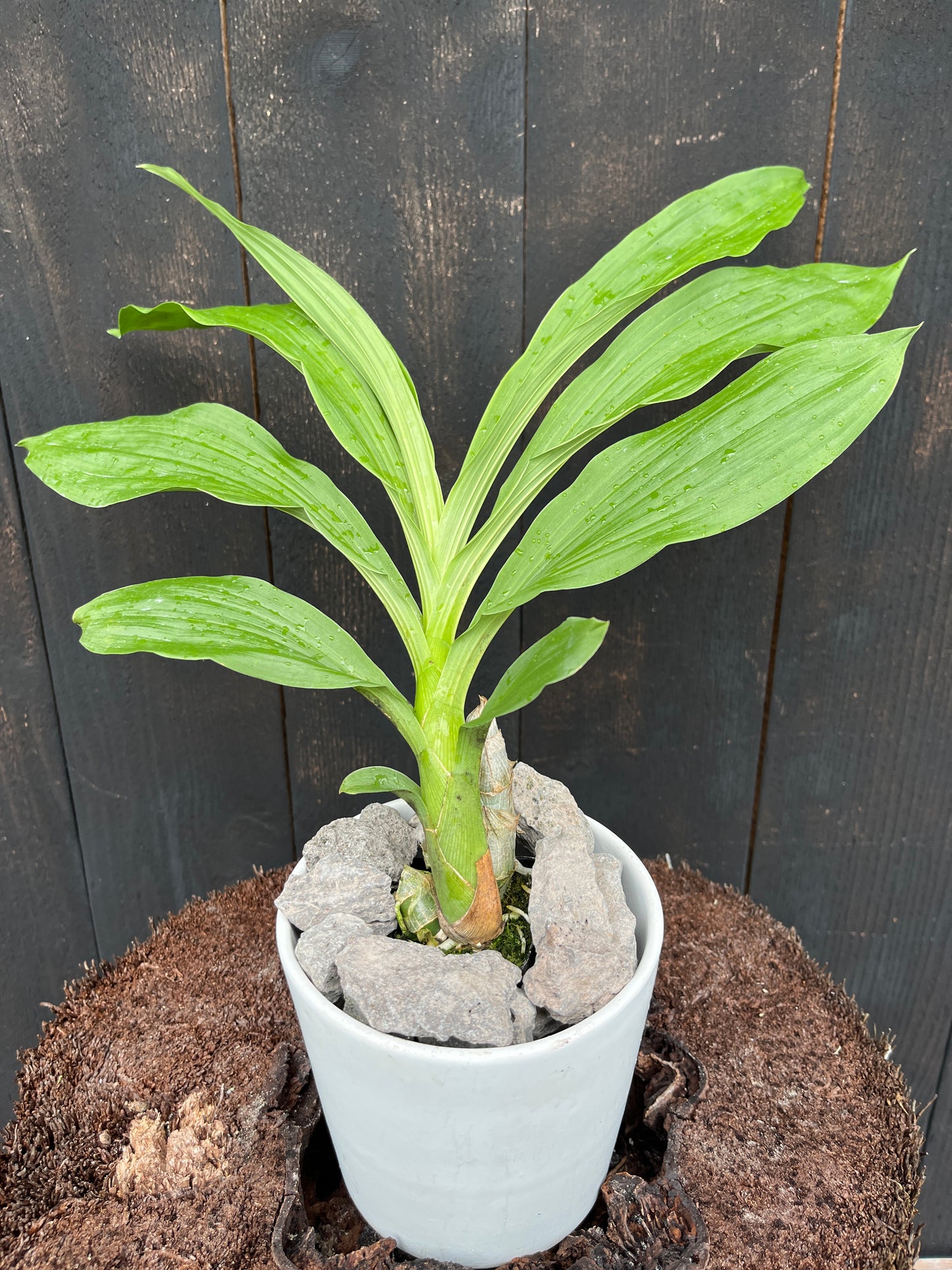
The hybrid orchid resulting from the cross of Cycnoches cooperi 'Dark Star' and Cycnoches Richard Brandon 'Heavy Spots' produces dramatic, highly fragrant flowers with a distinctive swan-like form. The blossoms inherit the rich coloring of their parents, showcasing deep bronze, copper, or chocolate brown base tones that are overlaid with dense, heavy burgundy spotting. The flowers are arranged along arching or completely pendant spikes that cascade beautifully from the upper nodes of the plant. A captivating, sweet scent is released by the blooms during peak daylight hours. Like other members of the genus, this hybrid displays floral dimorphism, meaning the plant can produce entirely male or female flowers depending heavily on the light levels and environmental factors present while the flower spikes develop.
The plant itself features robust, upright, spindle-shaped pseudobulbs that typically reach heights between 8 and 14 in. at maturity. These thick, fleshy stems serve as critical storage organs for moisture and nutrients, allowing the orchid to endure its native seasonal fluctuations. Emerging from these pseudobulbs are broad, light green leaves with clear, parallel veining that give the foliage a pleated appearance. Because this orchid belongs to the deciduous Catasetinae alliance, the leaves naturally turn golden yellow and drop away completely in late autumn or early winter, leaving behind bare, silvery pseudobulbs that remain dormant until the following spring.
Quick Start Summary
Light: Bright filtered light, avoiding direct afternoon sun
Temps: Warm to hot during active growth between 75 and 90 F, dropping cooler during winter dormancy
Water: Heavy and frequent watering while growing, drastically reduced to once every two weeks during winter rest
Humidity: High levels between 60% and 80% with constant air movement
Fertilizer: Balanced orchid fertilizer applied weekly at full strength only during active summer growth
Media: Free-draining mix such as medium fir bark combined with charcoal and perlite, or tightly packed sphagnum moss
🌺 Orchid Lore & Discovery
This sophisticated hybrid combines the genetics of Cycnoches cooperi, a species renowned for its rich bronze coloring and native to the warm, seasonal forests of Peru and Brazil, with Cycnoches Richard Brandon. The ancestral species in this lineage naturally grow as epiphytes on the lower branches of canopy trees and on rich, decomposing logs along tropical river valleys. These regions experience a climate defined by months of intense, daily monsoon rains followed by a severe, extended winter dry period. This evolutionary background is what drives the rapid vegetative growth of the hybrid during summer and its dramatic complete leaf loss and rest requirements during the winter months.
🌿 How to Grow Cyc. cooperi ‘Dark Star’ x Cyc. Richard Brandon ‘Heavy Spots’
Light: Provide medium to high light levels consisting of bright, diffused sunlight. Positioning the plant near an east-facing window or a shaded south-facing window offers excellent illumination. The intensity of light received during the early emergence of the flower spike can influence the sex of the blossoms, with brighter conditions typically triggering fewer but larger female flowers, and moderate shade encouraging a greater abundance of male flowers.
Temps: Maintain warm to hot temperatures throughout the spring and summer months when the orchid is actively producing new leaves and roots. Ideal daytime temperatures range from 75 to 90 F, with a slight drop at night. During the winter dormancy phase, the bare pseudobulbs can tolerate cooler conditions down to 60 F, but they must always be protected from freezing drafts and frost.
Water: Implement a strict two-phase watering schedule that coordinates with the seasonal cycle of the orchid. In spring, wait to water heavily until new growths emerge and their fresh roots are at least 3 to 5 in. long, as premature watering can easily cause the young shoots to rot. Once established, water heavily and frequently to keep the medium consistently moist throughout the summer. When the leaves yellow and drop in autumn, halt regular watering completely, providing only a light splash once every two weeks to prevent the bulbs from shriveling excessively.
Humidity: Maintain atmospheric moisture levels between 60% and 80% throughout the entire year. Excellent air movement is necessary when keeping humidity this high to prevent stagnant moisture from creating fungal spotting on the broad, thin foliage. Running an oscillating fan near the growing area helps maintain the appropriate environmental balance indoors.
Fertilizer: Feed the plant heavily only when it is actively producing new leaves and pseudobulbs. Apply a balanced orchid fertilizer at full strength with every watering during the peak summer months, as the plant must store a massive amount of energy in its pseudobulbs over a short period of time. Stop all fertilization completely as soon as the foliage begins to drop in autumn, and do not fertilize during the winter dormancy.
Media: Select a potting medium that retains abundant moisture during the hot summer months while still allowing for rapid drainage. Tightly packed sphagnum moss in plastic or clay pots works exceptionally well for growers in drier home environments, while a mix of fine fir bark, perlite, and charcoal is ideal for those growing in high-humidity greenhouses. Repotting must only be performed in the early spring just as new growths appear and before the fresh roots grow long enough to be damaged during handling.
Grown in 3" pots.
Share