

Kalapana Orchid Farm
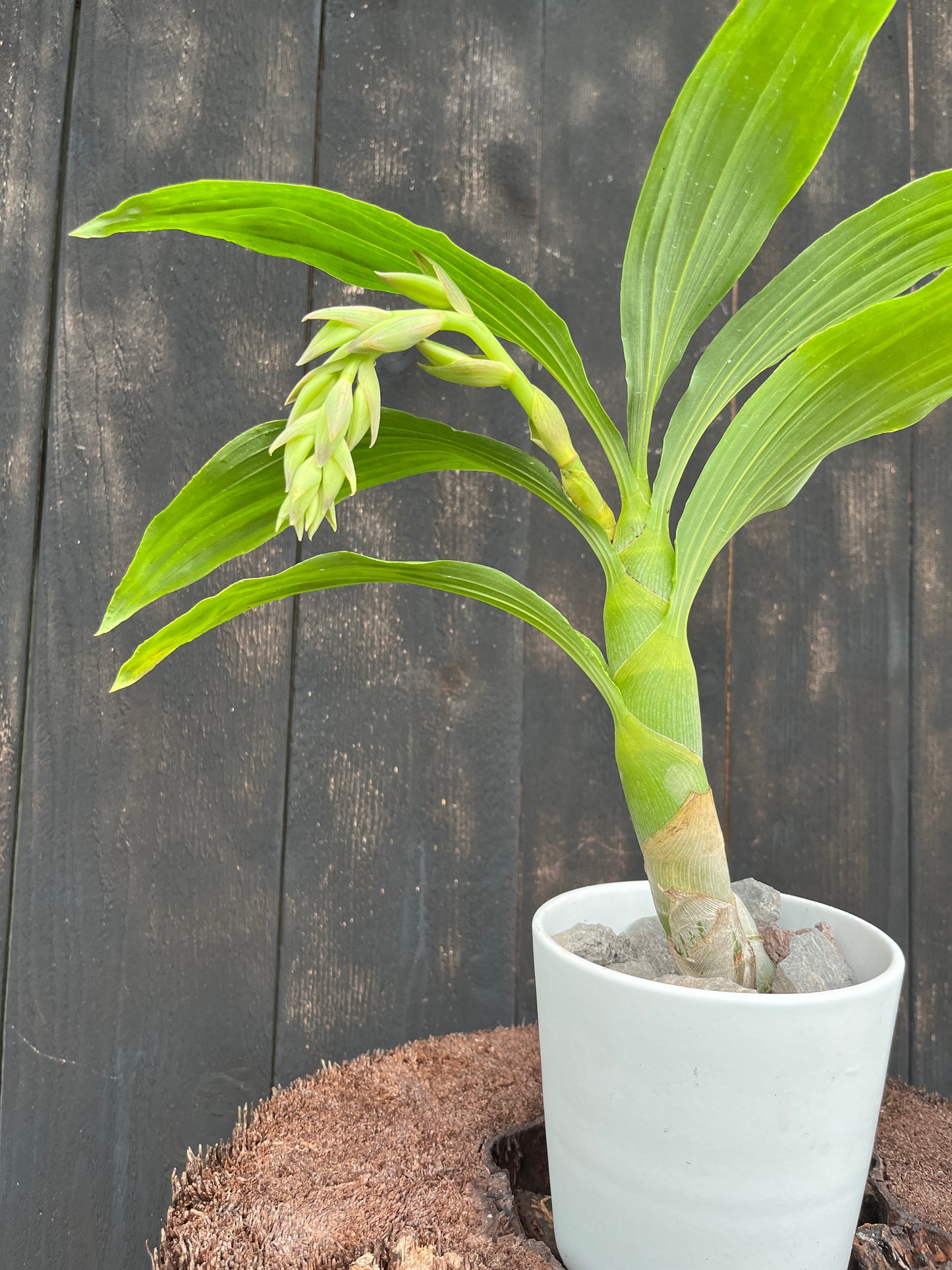
Cyc. The Grinch 'Copper' x Cyc. cooperi 'Super Dark' AM/AOS
Cyc. The Grinch 'Copper' x Cyc. cooperi 'Super Dark' AM/AOS
Couldn't load pickup availability
The swan orchid cross of Cycnoches The Grinch Copper and Cycnoches cooperi Super Dark AM/AOS presents a compelling display of the Catasetinae subtribe. The flowers are highly glossed and fleshy, taking on a dramatic, down-curved posture that mimics the elegant neck of a swan. This particular pairing intensifies the deep tones of the parents, yielding blooms that range from a rich bronze-chocolate to saturated copper-mahogany. The lip of the flower is complex and intricately fringed, often showing lighter contrast against the darker petals. A distinct, spicy fragrance reminiscent of chocolate and warm cloves is released by the blossoms during the day.
The plant itself is characterized by robust, fleshy, spindle-shaped pseudobulbs that store water and nutrients to sustain the orchid through its seasonal life cycle. These structures can grow to over 10 in. tall under ideal conditions. Arranged along the pseudobulbs are broad, veined, light green leaves that form a fan-like appearance. As a deciduous orchid, this plant naturally sheds all of its foliage in late autumn or winter, leaving bare, silver-sheathed canes during its winter rest. The pendulous flower spikes emerge from the upper nodes of the mature pseudobulbs, producing cascading chains of blooms.
Quick Start Summary
Light: Bright filtered light
Temps: 75 to 85 F days, 60 to 65 F nights
Water: Copious watering during active growth, completely dry during winter dormancy
Humidity: 60 to 80 percent
Fertilizer: Heavy feeding weekly with high nitrogen during active growth
Media: Sphagnum moss or fine bark mix in plastic pots
🌺 Orchid Lore & Discovery
The genus Cycnoches was first established in the early nineteenth century, named after the Greek words for swan and neck due to the long, slender, gracefully curved column found in the male flowers. The species behind this hybrid, including Cycnoches cooperi, are native to the warm, humid, low-elevation forests of Peru and Brazil, where they grow as epiphytes on tree trunks and rotting logs in open canopies. A fascinating biological trait of Cycnoches is their ability to produce separate male or female flowers depending on environmental conditions, particularly light intensity. Stronger light levels often stimulate the production of female flowers, while moderate, filtered light encourages cascades of the highly complex male flowers.
🌿 How to Grow Cycnoches The Grinch Copper x Cycnoches cooperi Super Dark AM/AOS
Light: Provide bright, dappled light throughout the growing season. An east or shaded south window is ideal, aiming for the upper threshold of cattleya light levels. The leaves should be a light chartreuse color; deep green indicates insufficient light.
Temps: This orchid thrives in intermediate to warm conditions. Daytime temperatures between 75 F and 85 F are optimal during the summer growing period, with a night drop down to 60 F or 65 F. Protect the plant from freezing temperatures and drafts during the winter.
Water: Watering must be tailored strictly to the growth cycle. When new growth appears in spring, withhold water until the new roots are at least 3 to 5 in. long. Once roots are established, water abundantly, keeping the media constantly damp. When the plant finishes blooming in autumn and the leaves begin to yellow, reduce watering significantly, stopping completely once all leaves drop.
Humidity: High humidity is essential to support the rapid development of the pseudobulbs and foliage. Maintain ambient humidity between 60 and 80 percent. Use a humidity tray or room humidifier if indoor air becomes dry, and ensure excellent air movement to prevent fungal issues on the soft foliage.
Fertilizer: This hybrid is a heavy feeder during its short, intense growing season. Apply a balanced or high-nitrogen water-soluble orchid fertilizer at half strength every week once watering begins in late spring. Continue this aggressive regimen until the pseudobulbs finish expanding in early autumn, then cease all fertilization entirely.
Media: High-quality New Zealand sphagnum moss in plastic pots is preferred by many growers because it retains uniform moisture during the rapid summer growth phase. Alternatively, a fine mix of tree fern fiber, perlite, and fine fir bark can be used. Repotting should be done annually in early spring just as the new growth begins but before the roots emerge.
Grown in 3" pots.
Share