
Kalapana Orchid Farm
Ons. Hilo Firecracker 'Sangria'
Ons. Hilo Firecracker 'Sangria'
Couldn't load pickup availability
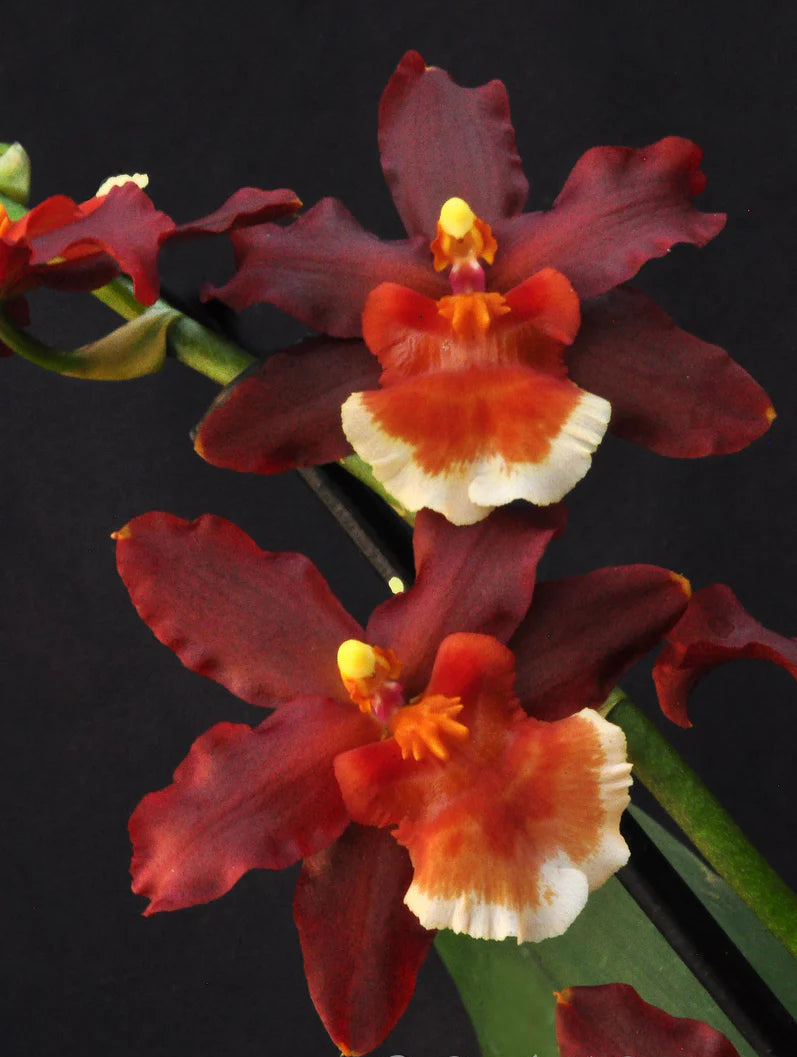
Ons. Hilo Firecracker 'Sangria' produces a cascade of relatively small yet vibrant flowers, creating a sensational display. The individual blooms are often described as star-shaped, featuring petals and sepals that transition from a fiery red at the base to an orange or yellow tip. The labellum is broad and prominently marked, typically showcasing a bright crimson or maroon color splashed against a yellowish background, which gives the orchid its festive and explosive appearance. These flowers are relatively long-lasting and are presented on gracefully arching, multi-flowered spikes that can reach lengths of 18 in. or more.
The plant exhibits the clustered pseudobulb growth habit typical of its parentage, which involves species previously classified under the Oncidium genus. The pseudobulbs are plump, oval-shaped, and usually colored light green, often bearing one or two thin, grass-like leaves from the top. The foliage is generally a lighter, more delicate green compared to Cattleya types and requires careful attention to watering to prevent shriveling.
Quick Start Summary:
Light: Medium-bright, indirect light, equivalent to an east or slightly shaded south window.
Temps: Intermediate to warm, ideally 60 F to 80 F. Protect from temps below 55 F.
Water: Water just as the media dries out at the surface. Do not allow the pseudobulbs to shrivel significantly.
Humidity: Moderate humidity, 50% to 60%, is sufficient for growth.
Fertilizer: Apply a diluted, balanced fertilizer with every third or fourth watering during the active growing cycle.
Media: Fine-grade fir bark, sphagnum moss, or a mix that provides excellent drainage while retaining some moisture.
🌺 Orchid Lore & Discovery
Ons. Hilo Firecracker 'Sangria' is a hybrid resulting from the cross Ons. Gold Dust and Ons. Oncidioides. This cross brings together two distinct lines of breeding to create a resilient and floriferous orchid. The name Oncidium has been restructured in recent years, leading to the reclassification of many popular types into the Oncostele (Ons.) genus, reflecting a deeper understanding of their genetic relationships. Regardless of the botanical name change, the parents contribute characteristics of tolerance and heavy blooming, making this orchid a highly reliable performer. The "Firecracker" epithet perfectly captures the dense cluster of brilliant, small blooms that appear to explode outward from the arching stem.
🌿 How to Grow Ons. Hilo Firecracker 'Sangria'
Light: Provide medium-bright light, avoiding intense, direct midday sun which can scorch the thinner leaves. East-facing light or bright, filtered south or west light is ideal. The plant should receive several hours of good brightness, but not so much that the foliage feels warm to the touch.
Temperature: This orchid thrives in intermediate to warm conditions. Day temperatures between 70 F and 80 F are preferred, with night temperatures dropping to 60 F to 65 F. A slight drop in temperature at night helps encourage healthy growth and spiking.
Water: Water just as the media begins to dry. Unlike thick-leaved orchids, these plants should not be allowed to remain bone dry for extended periods. Check the media frequently; it should feel barely moist when watering again. Insufficient water will cause the pseudobulbs to wrinkle and shrivel.
Humidity: Maintain humidity levels between 50% and 60%. While they appreciate humidity, good air circulation is crucial to prevent the spotting of leaves that can occur in stagnant, damp conditions. A gentle fan can be used to ensure air movement.
Fertilizer: Feed with a dilute balanced fertilizer (e.g., 10-10-10) at about one-quarter to one-half strength every one to two weeks during periods of active growth. Flush the pot with plain water once a month to prevent the buildup of salts from the fertilizer.
Media and Repotting: Use a moisture-retentive but well-draining media. Fine bark mixed with perlite or sphagnum moss are good choices. These plants appreciate being slightly under-potted. Repotting should be done just as new growth and roots begin to emerge, usually every one to two years.
Grown in 4" pots.
Share